




Step 1
Upload or import your paper
Drag and drop a PDF, or paste an arXiv link or a direct PDF URL. Your paper is indexed - title, authors, and metadata extracted automatically - and ready for questions in seconds.
A reading assistant that helps you deeply understand technical papers, right where you read them.
Used by students and researchers at Australian universities
University of Melbourne
University of Sydney
University of Western Australia
Curtin University
Monash University
The problem
The unfamiliar term. The dense paragraph. The figure you can't quite parse.
Without DraftN
PDF viewer, chatbot, notes app, search. You lose your train of thought chasing a definition across four tabs.
With DraftN
Highlight the term, get an explanation at your level, in place. No extra tabs, no lost context.
Without DraftN
Pasting text into a chatbot strips the paper's structure. Generic summaries, no citations, nothing you can verify.
With DraftN
Every answer shows the paragraph and page it came from. Click through and check it yourself.
Without DraftN
General AI tools are built for business reports. They oversimplify, skip equations, and ignore figures.
With DraftN
Built for technical reading. LaTeX renders properly, and you can ask about any figure directly.
How it works
Three simple steps to go from confused to confident.
Step 1
Drag and drop a PDF, or paste an arXiv link or a direct PDF URL. Your paper is indexed - title, authors, and metadata extracted automatically - and ready for questions in seconds.
Step 2
Highlight a single term, a sentence, or a paragraph. Choose to Explain, Summarise, or Define. You control the scope - the assistant stays grounded in what you selected.
Step 3
Every response is derived from the paper itself, with precise page citations you can click to jump straight to the source. Full LaTeX and markdown support for clean notation.
Features
Selection
Highlight a single word, a sentence, or an entire passage in the PDF.
Choose to Explain, Summarise, or Define it - and get a response grounded in that exact selection.
The same precision extends to the assistant's responses. See a term in an explanation you don't follow? Select it and ask again. Read, ask, understand, dig deeper - without ever leaving your paper.
Attention Is All You Need (2017) — Abstract
AlphaFold utilizes the Evoformer architecture to simultaneously process multiple sequence alignments (MSAs) and pairwise residue relationships, followed by a Structure Module that uses Invariant Point Attention (IPA) to predict 3D coordinates.
The system is trained through self-distillation — incorporating high-confidence predicted structures from unlabeled sequences back into the training set — and a BERT-style objective that masks residues to help the network learn evolutionary patterns.
It achieves high accuracy (median 0.96 Å r.m.s.d.95, a measure of average distance between atoms) by using the Frame-aligned point error (FAPE) loss, which ensures atoms are correctly positioned relative to local residue frames.
Citations
Responses are grounded in your paper, not generated from training data. Every answer includes clickable page citations - click one and the viewer jumps to the exact passage with the relevant text highlighted.
Your conversations are saved per paper. Come back days later and pick up exactly where you left off.
Technical rendering
Responses display LaTeX, mathematical notation, and formatted tables exactly as they should appear. No broken symbols, no garbled formatting - just clean, readable answers that match how your field actually writes.
Adam: A Method for Stochastic Optimization — Section 2
As explained in section 2, Adam utilizes initialization bias correction terms. Let be the gradient of the stochastic objective , and we wish to estimate its second raw moment using an exponential moving average of the squared gradient, with decay rate . The update at timestep of the exponential moving average = · + (1 − ) · can be written as a function of the gradients at all previous timesteps:
Cryogenic electron microscopy maps are three-dimensional reconstructions of macromolecular structures, such as proteins, created by capturing images of samples that have been flash-frozen at extremely low temperatures to preserve their native state. These maps provide a density visualization that researchers use to determine the precise spatial arrangement of atoms within a biological molecule. In this research paper, the authors note that AlphaFold's high-accuracy predictions have already assisted the experimental community in interpreting these complex maps.
Depth control
Switch between undergraduate and graduate-level explanations with one click. New to the topic? Get clear foundations. Deep in your research? Get the full technical detail.
Visual understanding
Select any diagram, chart, or figure in the paper and ask questions about it. The AI explains what's shown - architecture diagrams, flow charts, data plots - in the context of the paper it comes from.
No more staring at Figure 3 wondering what the arrows mean.
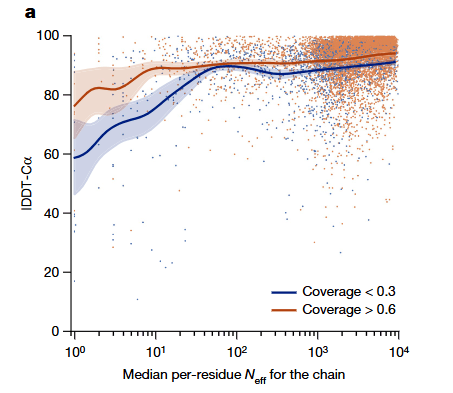
This diagram from the AlphaFold research paper illustrates how the accuracy of protein structure predictions depends on the amount of available evolutionary information. The y-axis measures accuracy using lDDT-Cα and the x-axis represents MSA depth (Neff).
The plot reveals a clear threshold effect...
Focus responses on a page range for targeted answers.
arXiv or direct PDF links
Organise by topic
As text file
Find past answers
Mobile, tablet, desktop
Titles and authors extracted
Pick up where you left off
Import instantly
Use cases
Make sense of your readings, week by week
You've been assigned a dense 30-page paper the night before your tutorial. You don't need a summary - you need to understand the core argument well enough to discuss it.
Upload the paper, select the passages that lose you, and get explanations at a level that actually helps. Organise readings by unit. Search past conversations when exams roll around.
Go deeper, faster - without losing rigour
Working through a stack of papers for your literature review. Some are in your field; others are adjacent disciplines where the terminology is unfamiliar.
Import from arXiv or a direct PDF link. Use page focus to zero in on methodology sections. Toggle to Technical mode when you need the full detail. Export threads as research notes.
Stay current across disciplines, not just your own
Reviewing a paper from an adjacent field for an interdisciplinary project, or preparing to teach material outside your core specialisation?
Orient yourself on unfamiliar terminology and methods. Toggle depth depending on whether you need a high-level orientation or a detailed breakdown. Every answer is verified with citations.
Why this is different
Most AI reading tools are built for anyone reading anything. We built this specifically for people who read technical, complex material and need to genuinely understand it.
Asked of “Highly fragmented European wetlands with uneven restoration needs”, Nature, 23 July 2026
According to the paper, 20.4% ± 3.4% of Europe's seminatural open wetland area is affected by human activities. For carbon, the authors estimate a potential soil-carbon stock loss of 0.84–4.87 Gt CO₂-equivalent relative to an undisturbed baseline. An important qualification is that this is a stock difference, not an annual or cumulative emissions estimate.
Human disturbance: An estimated 20.4% ± 3.4% of Europe's wetland area is affected by anthropogenic disturbance; 13.6% ± 3.0% is classified as most disturbed.1
Potential soil-carbon loss: Relative to an undisturbed baseline, disturbed wetlands could have lost 0.84–4.87 Gt CO₂-equivalent — approximately 10–11% of Europe's mean wetland soil-carbon pool. This is a 2018 stock difference, not an annual emissions rate.47
Pricing
Upgrade anytime. Cancel anytime. No lock-in.
Free
$0
forever
Includes:
1 paper
50 pages per paper
50 messages / month
Pro
$12
USD / month
Includes:
Unlimited papers
Unlimited chats
50 pages per paper
Priority support
Fair use limits apply to help prevent automated abuse and protect the experience for everyone.
Try it for yourself. Free to start, no credit card required.